Welcome to the Home Page for Physics 495
Special Relativity

Fall 2009 Daniel Finley
Monday and Wednesday, 5:30 - 6:45 PM , in Room 184, PandA Bldg.

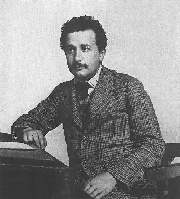
young Einstein, as a clerk Albert Einstein,
in 1939
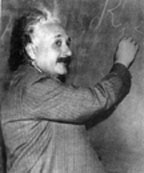
Einstein with blackboard

Einstein   (1879 - 1955)

This course is intended for the general knowledge of students of physics, in all areas.
This should include advanced undergraduates and also graduate students.
We will go into more depth than is common in other classes, where special relativity is only a small part of the course material,
concerning both underlying, fundamental principles and detailed knowledge of useful and interesting approaches.

Texts:
Relativity: Special, General, and Cosmological, (2nd Edition, paperback), by Wolfgang Rindler,
which concentrates on basic principles, philosophical approaches, etc. more than many texts,
A First Course in General Relativity, (2nd Edition, hardback), by Bernard Schutz,
which, despite the title, spends the first 100+ pages on special relativity, where we will be reading,
and also my own handouts on various additional topics, which will be made available on this webpage.

Brief Listing of Topics for Syllabus:
extension of physical vectors from 3- to 4-dimensional vectors: displacement, momentum, force, acceleration
some (other) 3-vectors require extension to 4-dimensional tensors: angular momentum, magnetic field, energy density
some interesting 1+1- and 2+1-dimensional "paradoxes"
differential forms and metric tensors; the Grassmann algebra of 1-forms, and application to magnetic monopoles
area, volume, and hypervolume, each as differential forms, to "sit" under integral signs
rotations and Lorentz boosts between reference frames: the full structure of the Lorentz and Poincaré (Lie) groups, and their Lie algebras,
and their representations, with application to the Thomas precession of dipole moments
motions of observers moving under constant acceleration, as measured by themselves
2-dimensional spinors, applications to the Dirac equation and other things

The different links on this page allow you to find, for instance,
Therefore, please consult this page regularly, to see what new things have been added.

Because of the variety of students expected in the class I will be pleased if everyone in the class will assist me in deciding what material we will discuss, and what level. The first version of such decisions has been put in the more detailed description already mentioned above.
The following are some general comments about the anticipated structure of the course.

Homework Assignments

will be posted here as they are assigned.
Homework is due at the beginning of class on the day in question!
    All assignments, and their solutions, are .pdf files, readable via Adobe Acrobat.
     
  1. Homework No. 1: due Wednesday, 2 September.
    After class on the due date, the solution may be accessed from this link.
  2. Homework No. 2: due Wednesday, 9 September.
    After class on the due date, the solution may be accessed from this link.
  3. Homework No. 3: due Wednesday, 16 September.
    After class on the due date, the solution may be accessed from this link.
  4. Homework No. 4: due Wednesday, 30 September.
    After class on the due date, the solution may be accessed from this link.
  5. Homework No. 5: due Wednesday, 7 October.
    After class on the due date, the solution may be accessed from this link.
  6. Homework No. 6: due Wednesday, 14 October.
    After class on the due date, the solution may be accessed from this link.
  7. There will be an exam on Wednesday, 21 October. You may bring with you any personally hand-written notes you like.
    Solutions are now posted at this link.
  8. Homework No. 7: due Monday, 9 November.
    After class on the due date, the solution may be accessed from this link.

Handouts of additional material, [in .pdf-format].

  1. Minkowski diagrams, some help and examples.
  2. Summary of (3-dimensional) boost transformations for 4-vectors, and also 3-velocity, 3-acceleration, and 3-force.
  3. Notes on the Geometry of spacetime, and associated Vector, Tensor, and Matrix Notation and Conventions.
  4. Groups and Algebras
  5. Tangent Vectors and Differential forms: Geometrical requirements
  6. Notes on the Rotation Group
  7. Notes on the Poincaré Lie Algebra, its commutators and something about representations.
  8. Lorentz Transformation Laws for Electromagnetic Fields, and also E, B, F, and A for a moving, charged particle, all from Coulomb's law
  9. Notes on Spinors.
  10. Notes on Magnetic Monopoles, and also a copy of a paper by C.N. Yang on magnetic monopoles.

Some interesting links to other webpages.

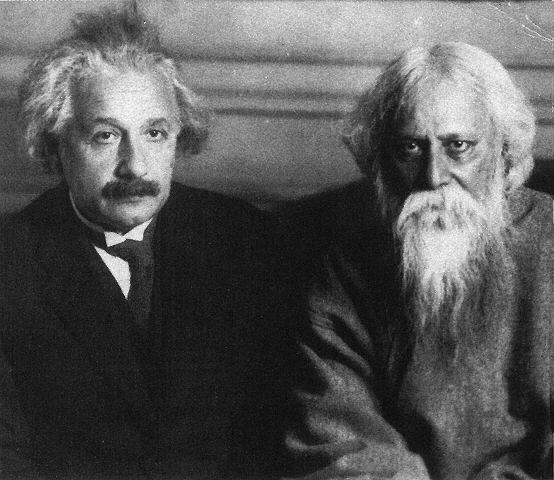
Albert Einstein and Rabindranath Tagore,
both Nobel Prize winners

To return to the top, click here.

Click here to mail your comments and suggestions concerning the Homepage Click here to go to Finley's own Home Page Click here to go to the Physics and Astronomy Department Home Page.

Last updated/modified: 26 August, 2009