|
|
|
|
|
|
|
|
|
 |
 |
 |
 |
 |
 |
 |
 |
|
 |
 |
 |
 |
|
||||
 |
 |
|
||||||
 |
 |
|
||||||
 |
|
|||||||
 |
 |
 |
|
|||||
 |
 |
 |
 |
|
||||
 |
 |
 |
 |
|
|
|
|
|
|
|
|
|
|
|
|
|
|
|
|
|
|
|
|
|
|
|
|
||||
|
|
|
||||||
|
|
|
||||||
|
|
|||||||
|
|
|
|
|||||
|
|
|
|
|
||||
|
|
|
|
|
 |
Miscellaneous To be blessed with a sharp focus in life is given to only a few in this world. I am not one of them. This allows me to do only 'sketches' rather than finished perfections in whatever I undertake. Clearly, this is unfortunate. It is also fortunate: I am freed of the need to concentrate. I can hang loose and dip into that which pleases at a given moment. Here, in the relative safety of this appendix-like nook of my web page, it is my intention to launch into the web objects I have collected outside of science. I do this with a comforting feeling of irresponsibility. Please enjoy these objects if they give you joy. Their authorship is not important. They should be looked at as found objects, not objects made by some one. And please, it is best not to communicate with me about them.
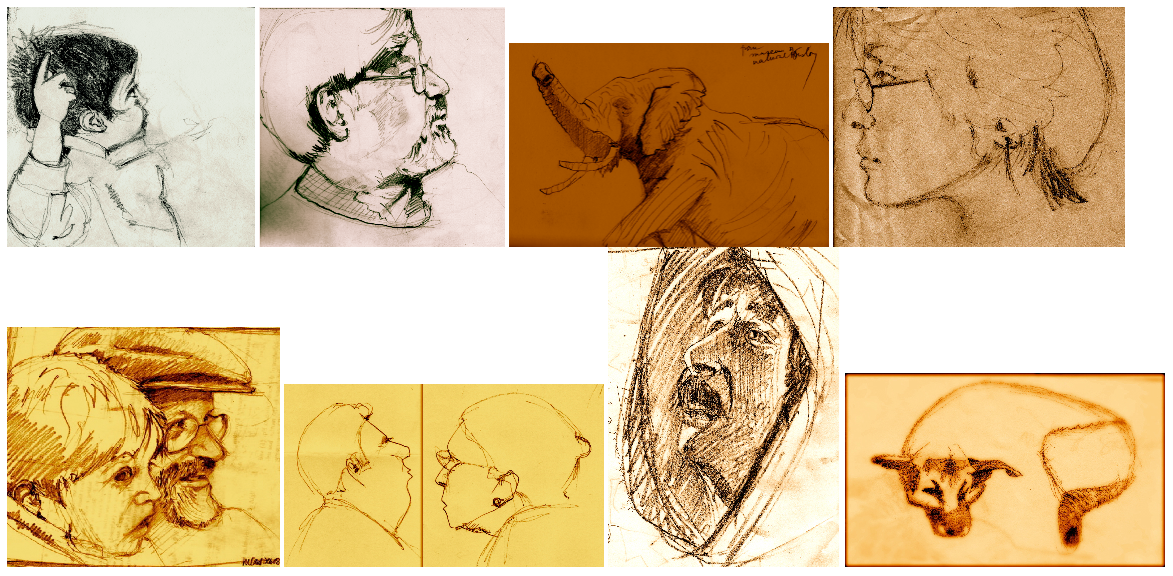
Faces I Have Met
1962-64 The staccato noise of the ferryboat between Agassaim and Cortalim that day in 1962 is clear in my ear. My father was engaged in conversation with a short crisp-looking man and the language was Portuguese. I was looking at the churning waters of the Zuari and thinking of Masefield’s sea fever (“I must go down to the seas again, to the lonely sea and the sky...”). For I fancied myself a poet in those days and, as a young man will, lived in a state of obsession on that basis, a state that was a mixture of romance, emotion, and unknowing intellectual self-deceit. I spent long evening walks on Rua d’Ourem and by Beira-Mar in Fontainhas with my poet-in-arms friend Tony Gomes and once tricked my more left-brained friend Frank Braganza (with whom the walks and talks were more rational) into heaping much praise on silly lines I had written which I still remember: “Like that setting sun sinking slowly into the depths of the sea, is my last hope dying... And like that blood-filled water, is my heart all bleeding...” before he knew they were mine. He knew even then that I was a subtle bag of pretense. In this shrewd evaluation he has been joined with the passage of time, slowly but surely, by many close to me, ending, painfully, with myself--one is always the last one to know such things about oneself. In any case I was sure those days, with a degree of certainty natural to fifteen-year olds, that there were two kinds of people in this world, the writers (or poets) and the mathematicians (or scientists), and that I belonged clearly to the former. As, leaning over the rail, trying desperately to see worthwhile poetry in the chaos (didn’t Masefield say something about blown spume, and couldn’t I do likewise?), I enjoyed the turbulent currents our ferryboat produced in the river by its passing, my father touched my arm and asked me to join in the conversation. “I understand you do not like mathematics, young man.” Thus started the stranger, eloquent, resourceful and engaging. Stubborn as I used to be, I was quickly caught in an intriguing net he wove around me of what mathematics really was, and, before I knew it, I had been ensnared. The man said that he was going to teach me trigonometry among other disciplines within a monthwhen Dhempe College would start for the first time ever, taking in students. Liberation of Goa from the Portuguese had just occurred only a few months earlier. Habits of 400 years were changing. Why not my conviction which was only a dozen years old (less than my age surely) that mathematics was for the birds? Within a quarter hour of conversation, the stranger had cast his spell of mathematics and had changed the course of my life to come. The stranger’s name was Joe Menezes. Dhempe College gave my friends and me many other dedicated teachers: Nadkarni teaching mathematics in a systematic way turning corollaries and lemmata from foes to friends, Harite converting impossibly difficult concepts in organic chemistry to digestible chunks, Sukhtanker centering on the mysteries of physics and stopping students from running away from centrifugal forces, Antão,Vaz and Lawande (junior Lawande to be exact--since there was also senior Lawande, the friendly despot, our beloved Principal, whose booming voice in college corridors and NCC fields still reverberates in my ear) and Ashataee and Daliyataee, one who could discuss P. G. Wodehouse as well as physics, the other who could command and march sternly in parades when not teaching physics. Memories crowd also about colleagues: other students who have since disappeared completely from circles accessible to me. Among them two other K’s: Kosambi who would always beat me in chess no matter how hard I tried, and Kirtani who always wrote everything neatly in his beautiful handwriting no matter how fast he had to take notes. I wonder where they are now. And I remember, with heart-wrenching pangs I cannot dispel, a few who have departed from this world, I cannot understand why: Subhash Rao, the handsome young man who became my brother-in-law but not for long, and Marina Flores, my childhood friend who married my dear friend Tony Gomes and then one day decided to leave him and us all. Everything in Dhempe College was magical. The tall doors and long classrooms of the college buildings which were but the vacated edifices of the Liceu Nacional Afonso de Albuquerque, the beautiful trees in the quadrangle, and the dashing spiraling steps that dropped down to the Corte d’Oiteiro. Even as we struggled to learn mathematics and language, science and art, intoxicating youth was enveloping us all. We fell in love, often secretly. We wrote poetry, affected philosophy, discussed everything under the sun. And then the two years passed. To many others I am sure they did take twice three-hundred-and-sixtyfive days. My own conviction is that they were over in two days. Or in another sense that they were the only life I have ever led: they were an eternity. Time is quite unclear in my mind about those charming, spell-binding, unreal, dream years from 1962 to 1964. What has happened since? Not much, I am afraid. The next four years I spent in IIT Bombay, studying Electrical Engineering, and then three years in Stony Brook in the USA doing Theoretical Physics. A career doing research in physics, teaching, trying to pay back in some strange indirect manner some of what I was given by wonderful teachers in my Dhempe College. I live in the USA but my career has led me to many countries in Europe and South America in particular, allowed me to enjoy many cultures, face many situations.Multifaceted personalities have crossed my path, some kind, some vicious. From all I have tried to learn (whenever I have been ‘awake’ enough to learn): from the good ones what to do, from the others what not to do. I have erred more often than not. As a kid, I used to think that every day and every year, I would improve as a person: that I would turn into a better student, a better professional, a better person. That, alas, has not happened. At fifteen and sixteen I knew it all. Now I am not sure of anything at all. But through all this growing up, what brings a pleasant half smile to the face (in the language of the Theravada Buddhist) is memories of those two years 62-64 in my Dhempe College.
Father When I prepare a lecture, I talk to myself. I go for long walks where no one can hear me or see me mouthing my oratory. The spontaneity helps and the thoughts form themselves into a structure that is loosely held in memory. Typically two such attempts are sufficient. The first to form the lecture, the second to time it. My friends have often asked me where I came by this mode of preparation. The other day the answer came in a flash. A long forgotten picture arose from childhood memory. Sitting on the middle bar of a bicycle, held securely by my Father riding, a strong moist wind against my cheeks, the last remnants of twilight disappearing, streetlamps zooming by us one by one, their speed determined by Father's pedalling. Lovely sleep sitting heavy on my eyelids, making it a battle to remain awake so as not to fall off the bike, an occasional infrequent car swooshing by, water from the road thrown onto the bicycle, and, through it all, Father talking to himself preparing his lecture for the next day. My father held two jobs, as a draftsman in the Public Works Department and as a teacher in the Portuguese lyceum, a secondary school. By training he was an artist -- a painter. As a student of Fine Arts he lived steeped in the works of Rembrandt and Velazquez, Rubens and da Vinci. As a man interested in acquiring a living, he found none of that of help. Art as livelihood has seldom been lucrative anywhere in the world. Goa, then a small Portuguese colony in India, provided no exception to the rule. He could have made a passable living by staying in Bombay, a large Indian city where he had acquired his art training and where most of his fellow students settled. But idealistic views of bettering art appreciation in his native Goa came in the way. Earning money as an artist was impossible in Goa. He used caricatures of his true profession to make a living, working first as a photographer, then as an occasional tutor, a draftsman, and finally as a teacher of drawing and mathematics. He came from a family of master story tellers, honest to a fault, and largely uninterested in money. They seemed to be particularly proud of being men of their word rather than men of the world. Father would tell us that my grandfather's word was used as idiom in those parts for the ultimate promise. My grandfather as well as my uncle -- Father's oldest brother -- were cloth merchants. Notoriously unsuccessful businessmen, in their later years they lost whatever money they had made in the earlier ones. My uncle sold the cloth shop and lived as a clerk in that very shop working for the new owners until the end of his life. My grandfather died many years before I was born. I know little about him although Father, who had named me after my grandfather, half the time thought of me as him returned from the next world. However, I remember my uncle, a peace-loving man who would laugh at every opportunity and from whom affection flowed naturally and malice was unimaginable. I have heard it said that he raised his voice not once in his life. He told me many stories particularly at siesta time after the afternoon meal. I would lie in bed with him. The afternoon heat meant that he slept without his shirt. He had thick grey hair on his chest. I would rest my head in that whiteness, hearing his heartbeat while he told me stories which were skilful in the telling and skilful in the planning -- they would marvelously end just as he would begin to snore. He told me many stories of all kinds but the one that stands out clearest in memory is about a sleeping giant who was so large that men traveling towards his ears to sound the waking alarm lost their way and fell into his nostrils, and were then trapped for weeks disoriented in the vast spaces. Desperation descended upon them when they encountered another group of men in that darkness who told them that they had been trying to find a way out for more than a year! My uncle introduced me to photography by buying me a small camera. The first picture I took with it was his while he napped, the second my mother's while she ground spices. Both persons have passed away. Both photographs are lost in my papers. Like his oldest brother, Father had a flair for telling stories. His forte, however, lay in making them up. Many of our cousins would come spend the summer holidays with us specifically so that they could curl up around Father at night while he invented heroes and villains, created magic sounds of the forest through which they travelled, spoke of tablets of concentrated food that kept them from going hungry... every evening was a feast for the children. Father also had an unusual zest for life. He took the family for day picnics when such outings were unknown in the society around. From time to time he made arrangements for the family to spend 'mudanças' in distant villages. On one such occasion I remember helping him paint kilns in the day time and joining him learn canoeing from the fishermen at night time. My helping Father paint meant carrying the paraphernalia and squeezing paint tubes to fill his palette -- burnt sienna, burnt umber, vermillion, those were the wondrous names of the painter's colors. Our learning canoeing from the fishermen meant sitting with one of them in his ancient canoe watching him row in the moonlight, the silence broken only by oars splashing in the water, magic stripes of darkness and light interweaving on the lake. Father had an unusual approach to minor upsets in life. He insisted they were there to learn from. I remember the series of buses we missed once leaving us two stranded in Bardês, a region in the North of Goa. He walked miles with me in the scorching sun, easily making me forget the heat and the aches in my legs through his cheerful words and specific instructions on how to turn upsets into enjoyable experiences. I remember at the end of the long walk he found acquaintances in the village of Candolim who served us a hearty lunch and sent us on our way. 'Transtornos', he called such upsets, using a Portuguese word. It was Father who taught me Portuguese, the official language of Goa. He had an exceptional ear for languages. Under his tutelage I learnt to speak with a perfect Portuguese accent. While he himself would speak in the distinctive Goan style, paying respect to the popular notion that Goan adults who spoke like the Portuguese were show-offs, he wanted his son to speak the 'correct' way. His insistence on proper enunciation came from his interest in acting. He was an exceptionally gifted amateur actor, having played many leading roles on the Marathi stage includingChandrasena (Hamlet)in Agarkar's translation of Shakespeare's play. He imparted some of that love of the stage to some of his children. I remember him training me do dialogues in the role of Tanaji, the brave knight who gave his life for his king, and of Sambhaji, the drunkard king who repented his vice-ridden ways in his death cell. Every word had to be mouthed to perfection. Once the words were mastered, facial expression of emotion came next. It was hard training. Curiosity for all things characterized him. He would travel with engineer colleagues to distant sites of construction, sketching bridges and hydraulic plants. He would attend by special permission surgical operations conducted by his physician friends so he could observe and sketch those operations. My brother tells me that in the last year of his life he would try to walk every day to the beach to watch the sunsets, to store their multiple patterns in his mind. Father taught his children many things. To think for themselves. To take nobody's word as gospel, whether a teacher's, a parent's or a priest's. His style of teaching did not always rely on word. It was often based on deed. And sometimes on a remarkable sense of humor. I will never forget a train ride we took from Ghataprabha to Belgaon, in which, quite uncharacteristically of him, he allowed me to buy first class tickets. The two of us were the only occupants of the rail compartment. The train rocked on the tracks as it sped. Suddenly getting up from his seat, Father said with a smile, “Come let us dance to the music, watch how we can become one with the train.” For half an hour he and I danced, joyously but seriously, mentally merging with the train. Father died in 1984 after being in a coma for 3 months, a consequence of a stroke he suffered. I did not travel to see him while he was dying. I claimed it was because I wanted to remember him as he was in life, not in death. Rama's Pig Gods with bows letting loose enchanted arrows in search of evil monsters and demons formed the cultural heritage of my childhood: mythological figures of the Hindus lived daily with me, Rama with his archery, Maruti with his strength, Krishna with his chakra. For my uncle and father were master story tellers, and my mother extremely well read: she transmitted her love of books to me. But our house was also physically surrounded by huts in which Christian neighbors lived with their pigs who roamed freely. If you combine in a six-year-old's fancy dark pigs that runt and run, with demons that yell and flee the arrows of a Rama, you have explosive potential. Into such a situation entered one day around 1952 a gift given to me by my brother, eleven years older than myself. He was very fond of me. I would look forward to his return from college on vacations with great excitement. Once he brought me jeans. To a person in the Americas (where I live now) the word means merely something to wear: a pair of rugged pants. For us at that time jeans were wondrous. They had to be folded at the ankle end and had to be blue, and went with something to wear like a shirt--called a jersey. Wearing jeans transformed one into a cowboy and not just any ordinary cowboy, but into the fastest gun alive. On the occasion I am writing about, however, my brother had brought me something much more exciting than jeans or jersey. It was a bow and a set of arrows which could be placed in a quiver and strapped around the shoulders. Little wonder then that little Rama was out immediately looking for evil monsters to bring down with his archery. Maruti was created in a flash and went ahead scouting. I sighted a demon posing as a cocoanut tree trunk. Before he could transform back into his hideous form I had already shot my arrow into him. My brother watched and smiled to himself. Clearly he had brought a nice present for his little brother. He went into the house. I went after bigger demons. I had my arrow already fitted to my bow and sighted a worthy monster: dark, large, moving quickly. Long snout, evil nostrils moving in derision at my bow. Surely to slay these monsters is what Rama's birth was for. Moving on his four legs, the monster passed ten feet in front of me. Where was he going? To abduct Sita? To ruin Vishwamitra's sacrifices? I had to stop him. The twang of the bow and the scream of the pig sounded together. The poor beast, expecting none of this pointed treatment, was screaming. The arrow was sharp. While it did not kill the pig, it certainly hurt him. I knew Laxmana would hear the cries of the demon and leave Sita, and then Ravana would abduct Sita. No, I had to do better this time. This was an opportunity to correct the mistake recorded in the Ramayana. I quickly got another arrow from my quiver. A second scream of the pig who ran away with two of my brand new arrows protruding from his hide quickly ended my adventure. For the neighbor came running out of the hut to find out what had hurt his pig. The rest of the event is a blur in my mind. Heated discussions among the adults, apologies, and spanking which at that time certainly did not seem deserved at all, come back vaguely from the deep recesses of memory. I do remember that my bow and arrow were taken away from me and Rama had to go through the rest of his incarnation with imaginary weapons.
Eating a Mango When I was a child growing up among the pouring monsoons, the lush vegetation, and the tropical fruit of Goa, I knew of three ways of eating a ripe mango. The most civilized "the dullest" of the three began with the mango served to you in a dish, four neat cuts already made in it with a knife by someone else. A tiny one to slice stem from fruit, two broad slashes to separate the flat seed from the two fleshy halves, and two more cuts, perpendicular to the slashes, one on each half of the mango. You found yourself staring "pink flesh of the fruit peeking from under the green yellow red skin cover, sweet aroma filling your nostrils" at five edible units. A messy seed and four neat slices. If you were truly civilized, or what was the same in our eyes, a sissy, you ate only the four slices. For this you pulled one of them off, ripping the tiny part of the skin that attached it to the bottom end, the one away from the stem, and placed it, fleshy side down, in your mouth. Heaven rested briefly on your tongue. Your teeth sank into the juicy pulp as you held the end of the skin in your fingers and pulled it out. Your teeth left rake marks on the underside of the skin while sweet juice and delicious fruit deposited themselves in your mouth. You turned what you pulled out by one hundred and eighty degrees and repeated the raking action. A few more of the same, changing the angle, and you had in your hands a spent skin, stripped of pulp and juices, its underside like a paddy field before rice seeds are sown. You did this four times, then stopped if you were either fussy or lazy. If a connoisseur, you now proceeded to attack the core. Holding the seed with its flat sides exposed, your teeth peeled the narrow skin ribbon in the shape of a U and subjected it quickly to the same treatment as the slices. Now the naked seed settled in the crook of your thumb and first finger, its flat sides parallel to your palm. With lips fastened at the crook, you squeezed the trigger, the milking action pouring the most wonderful liquid flavor and fibrous taste into your mouth. You adjusted the seed in your palm every possible way to divest it of all its treasures. Of course you made a fruity mess in your palm, which you licked or washed depending on your level of eating sophistication. If you were good at this, when you flung the spent seed "which looked now like an old man's wrinkled face with disshevelled hair" at the neighbour's waiting pig, he grunted crossly at you because all you left for him was a dry seed to crack in his jaw. There was a nicer way to eat a mango which started with you pilfering the fruit directly from the basket where it was left to ripen, or perhaps from the tree itself. It was important to wash it and then to puncture it slightly at the stem end and squeeze out the few acidic drops. Then you held the mango in both your hands, put your mouth at the punctured end, breathed in deeply, shut your eyes for concentration, and sucked. Juices came into your mouth. You squeezed. Fibrous fruit flesh filled you with the ultimate pleasure in life. You squeezed the mango in multiple ways feeling the flat seed through the emptying skin bag. When you were satisfied, you popped the seed out of the skin, tearing the skin in the process, much as in the emergence of a new-born. The more sophisticated among us turned the skin inside out and finished it using the teeth raking technique, and the seed using the trigger squeezing procedure. But the most savage and fulfiling of the three ways was simply to tear the skin of the whole intact mango piece by piece, divest each piece of its riches first, and then, one's entire being focused into one's teeth and tongue, bite into the yellow red fibrous pulp, sweetness dripping from the corners of one's mouth, no thought or premeditation interfering with the spiritual experience of melding mango and oneself.
Carpet Weaving I recall a comment made by a physicist colleague many years ago that a quality lacking in today’s graduate students was the ability to stay on the job until the carpet was woven completely. This chance remark has stayed with me over the years. My profession at the university demands that I train graduate students to become practicing physicists. To be a good practicing physicist requires a multitude of qualities, tendencies, and skills, as I am sure to be a good practicing individual in any field of endeavor does. There is devotion to the subject, basic intelligence, curiosity, careful observation, intellectual honesty, creativity, and hard work. But there is one more with which I have always had trouble in my own development: refusal to be content with small achievements. The subtlety of the situation arises from the fact that the ability to be content with small achievements is also an important prerequisite to success as a practicing physicist. If one is always seeking after the grandiose, deep frustrations descend, in no time engulfing the individual in depression. One must learn to enjoy the little berries one picks in the field even as one prepares to hunt big game. What makes this whole business of training oneself or one’s students fascinating is that side by side with developing contentment with small achievements one must develop dissatisfaction with them. It is subtle. The contentment must come from their being achievements, however small. The dissatisfaction from their being small, even though they are achievements. One must enjoy every little joke but must not stop until the entire story is written. One must derive contentment from every little integral that is evaluated but not stop until the entire theory is constructed. This ability to enjoy each thread but not rest until the entire carpet is woven is very rare indeed. My own considerable capacity for enjoyment of work means that I can derive endless pleasure from noticing every morning afresh, and on my own, that exponentials and trigonometric functions are connected. Pleasure that keeps me going. But pleasure also that distracts me from the sure fact that these are, from the point of view of my own creative work, very useful trivialities. A John Bardeen does not stop until he has explained superconductivity, a Michelangelo until he has finished the Sistine Chapel. I am distracted by this little memory function, which through its singularity explains a little but does not have the staggering breadth and detail of a fully woven carpet. What is true of a physicist’s requirement is true of anyone else’s, of course. To be merely driven by the finished carpet would be terrible, perhaps impossible – or so I think. Rome was not built in a day. What did each day mean to the builder? Laying a brick here, raising part of a pillar there. If you do not know how to enjoy and excel at these, you cannot even live through the construction of Rome. And yet, if like mine, your contentment with the single brick well laid is, in effect, an obstacle in the way of the finished Coliseum, you are fated to remain a happy but smalltime player. In the language of the artist, you are forever limited to doing sketches rather than finished drawings. As I look within myself, I discover that I do not like to draw, only to sketch—leaving paintings unfinished is an obsession with me. This certainly gives me opportunity to immerse myself in a variety of experiences, and to perceive my surroundings in multiple ways. At the same time, it robs me of focus and makes of me a butterfly. Worse, it does not allow me to instill in my students the desire to weave carpets. Faced with this quandary, there is a prescription I have followed throughout my mentoring career. I share the totality of these thoughts about carpet weaving with my students, particularly in the last stages of their apprenticeship, realize that, after all, they teach themselves whatever skills they have, and, as they go out into the world to live on their own, whisper to myself that my own job in their training, however insignificant, is now truly at an end.
Horizontals versus Verticals Intense conflicts, intellectual and otherwise, have occurred over the centuries among the followers of Shiva and of Vishnu. In the South under the name of Iyers and Iyangars. Elsewhere as Smarthas and Vaishnavas. In the little society of Goa, as the Horizontals and Verticals, as per the direction of the mark of the vibhuti applied to the forehead. I am told that the conflicts in some regions have at times been fierce, involving battles and bloodshed. In my childhood I have overheard my aunt deriding the (Goan) Vaishnava custom of placing one's glass of water on the right of one's plate while eating. "People with inferior logic," she would say, twisting her striking face into a form so critical that were I a Vaishnava, I might never drink water again at my meal. My aunt's attitude was shared by many persons of either group in the little community of Goa,—I speak of the Hindu half of the Goan population. The Horizontals thought of the Verticals as at least slightly flawed, and the Verticals responded in kind. I do not know of events in Goa involving violence between the two, and it certainly was not every day that as good Horizontals we contemplated the obvious defects of the Verticals while being similarly pitied or insulted in their families, but there was an underlying dormant feeling of conflict. For instance, it was invariably with reluctance that one gave one's daughter's hand in marriage to a suitor from the opposite camp. Conflicts abound everywhere. But their absurdity is brought home to me most vividly in the Shaiva-Vaishnava context. Shaivas and Vaishnavas are both Hindus. Whether one finds appealing the ascetic representation of God in a form covered with ashes, or deems attractive the charm of another decked with garlands and ornaments, whether the noise of the thunderous damaroo (drum) and the march of Virabhadra are associated with one's devotional practices, or the soothing music of the flute and the soft flow of the Yamuna, these are both, ultimately, paths to the same concept. What matters is the reunion of the Atman with the Brahman, whether the primary instrument is disciplined meditation or loving devotion. Why then a conflict that has the potential to create hatred? Every time I shudder at the atrocities inflicted throughout the world by warring ideologies on each other, in history or at the present, I think of the conflict of the Verticals versus the Horizontals. Arabs blow up Jews. Irish catholics kill their protestant counterparts. Jews bomb Palestinians. Hindus war against Muslims. Al-Qaida fighters uproot American skyscrapers by flying airplanes into them. Americans rip to shreds the Taliban in response. Yes, of course, some of us are convinced some of these actions are retributions, even perhaps justifiable retributions. But has retribution ever quenched hatred in the history of mankind? Violence requires hatred to fuel it, and isn't it true that retribution always begets more hatred? Where does the hatred come from? From conviction on each side. Conviction of what? Of a model in one's mind of the Universe? Of whether there is or isn't a Creator? Of whether the Creator does or does not take personal form? Of whether it is proper to call Him Allah, Bhagawan or Christ? Why does it matter so much whether it is important to address Him by the first, second or third letter of the alphabet? Is this enough difference to kill? I am a physicist by profession. We are always engaged in conflicts about the way we think about the structure of a nucleus or the origin of a spectral line. Being human, we are unreasonably and egoistically attached to our convictions. We argue with passion. We rave and rant. But to defend or promulgate our beliefs, we never kill. And yet, the moment we divest ourselves of our scientists' hats and replace them with our religious trappings, calling ourselves a Hindu, a Muslim, a Jew, or a Christian, we become maniacal, homicidal. I have always been mystified by how this transformation occurs. In the American city I live in, a number of well meaning friends wish to build a Hindu temple. They have a very natural and understandable wish to worship as they have seen their fathers, mothers and uncles do, back when they were growing up in India. They want a place with walls to which they can go to attend harikathas, join in bhajans, listen to discourses on the Vedas. I am delighted to see this awakening of interest in religious roots. Yet, I oppose this temple building with every ounce of my strength. My friends who have heard me frequently coax them to steep themselves in their philosophical heritage, are astounded. They do not understand. They accuse me of arbitrariness in thinking. "Are you opposed to temples?" they ask me. "No, only to building walls which separate," I answer them. I urge my friends to band together, to sing bhajans, to discuss the Upanishads. But to do nothing which discourages a Muslim, a Christian or a Jew from participating. We do not build universities in which only wave mechanics may be investigated or the Schroedinger equation discussed and put barriers to keep out those who would expound matrix mechanics and indulge in operator algebras. We do not construct edifices to exclude those who uphold the Big Bang theory of the origin of the Universe and include only those who would pledge loyalty to the theory of continuous creation. Why then encourage artificial and dangerous segregation of the Hindus within temple walls? The peril is particularly great these days when we hear of separatist movements mushrooming everywhere. I fear the deadly poison in these mushrooms. There is no doubt in my mind that the essence of Hindu thought is tolerance. Perhaps tolerance not for its own sake but for the stand it takes against stultification of thought. "We, Hindus, will lose through this tolerance," retort my friends. They point out the mosques, the churches and the synagogues around. "They all proliferate their places of worship," they say, "and it is for that reason that we also should." Nothing frightens me more than this confession. It is precisely this sentiment that convinces me that I cannot join my friends in their construction activity despite the fact that I too love listening to discourses on the Vedas and being surrounded by bhajans. Even Vishnu and Shiva, the two inseparable elements in the Hindu Trinity, can inspire their worshippers to hurl insults, ridicule, and worse at one another and remain locked in struggle for centuries. What hope is there then for peace to reign among followers of the diverse faiths in the world?
Flight into Jackson Hole
The young woman behind the counter was less informed than I was. She pointed me simultaneously in all four directions of the compass. 'Hurry,' she also said, 'it is the last flight and it is about to leave.' Those two pieces of information were not new to me, and hurrying was certainly great advice. But in which direction was I to hurry? That detail was not clear to her. My wife and I hurried on, the carry-on I was pulling making reluctant squeaking noises on the floor. We were stopped by a long line, which was in the last of the directions in which the woman had pointed. 'Now we can relax,' I said to my wife, knowing that we could not go faster than the line. My wife put her hand baggage down. I patted my trusty carry-on on its shoulders for it had stopped its squeaking protests, and began a meditative pause the way my Buddhist teachers had taught me to do in tense situations, projecting my metta (friendship emotion) all around me. I was just tuning myself fully into the Universe when it suddenly hit me that this may not be the line for Jackson Hole after all. Shocking myself out of the repose I had been settling into, I asked the person ahead of me and learnt that I was right in my concern—he was waiting to travel westward to a place whose name I had never heard in my life. I pushed ahead. Squinting, I detected at the farthest possible end of an immensely long corridor, a little sign with what seemed to be the letters J and H. My failing eyesight showed me that the last person was just disappearing through that gate. I decided to take a chance and ran, shouting to my wife to follow. Bless her heart, she did. Indeed, it was the Jackson Hole gate! Had I not shaken myself out of my Buddhist reverie in time, we would have had to vacation in Salt Lake City instead of in Jackson Hole. Panting through the exertion of running, we rushed through the gate. There was no one to check our boarding passes. As soon as I arrived on the tarmac and saw the plane, an urge almost overpowered me to turn around and run the other way. I am scared to fly in small planes, and the contraption that was waiting to transport us to our destination was as tiny as they get. The emotion that takes hold of me in small planes is not a conscious fear that the plane might crash. It is a primordial terror, totally unconnected to reason. My wife, who is much more courageous in her ways, barred my way back, acting much like famous commanders in history who burnt their ships after landing on enemy shores. 'It will be alright,' she said, ignoring the livid face I presented. Invoking every god of the Hindus, and Allah and Jehovah and Christ to boot, I entered the little box with its propeller wings. My wife, who was considerably calmer than I was, found us a place and smiled her reassurance at me. I noticed that there were just four more passengers in the plane which, with our coming, was full to its capacity. I sat eyeing the bathroom door. It was not far from where we sat—nothing in the plane was far from where we sat. The stewardess spoke into her microphone. That was quite unnecessary since even her whispers could be heard everywhere in that tiny space. Her announcement was very interesting. I learnt that we would be in the air for an hour, that we were going to fly low, that it would get hot in the plane for most of the first part of the flight since the air conditioning had to be turned off to conserve energy, and that they were not serving any refreshments. 'At least I can go to the bathroom,' I said to myself, with gritted teeth and admirable control. The whirring of the propellers began. The beating of my heart increased in frequency. Fortunately, I happen to know a number of hymns from the ancient Vedas. I chanted the most important ones. They lifted the plane, perhaps with some help from the engines. We were airborne. The noise was deafening. The heat was unbearable. After what seemed like ages, I tried to get up to hop over to the bathroom—that need had reached emergency proportions. I noticed to my horror that the stewardess was shaking her head and mouthing some words. I cupped my ears. No! She could not be saying 'Out of order, I am sorry,' could she? Yes, she was saying precisely that. I wanted to either jump out of the plane or murder somebody. Unfortunately, I could do neither. An hour later, the plane came to a valley and began its descent into a narrow funnel-like space among the hills. It was dusk. Did the pilot have any instruments or was he flying merely by sight, I wondered. No instruments to speak of, I later learnt. The buzzing mosquito that was our little flying box, was searching for the proper time and the proper place for its landing. It buzzed and circled for a long time. I thought there should not be any strong winds in the valley, surrounded as we were by hills on all sides. But that particular valley seemed to be oblivious to that rule. The plane was being thrown violently from side to side. I crossed over my wife’s seat to the window, looked down and sensed the tiny airport hiding somewhere in the thick darkness that had gathered by now. Would someone please turn on the lights in the valley, I was pleading within myself. There was nothing left for me to do except, once again, to lend all the help I could to the pilot through my Vedic hymns. This time I had to chant every one of them. And many times over. It worked. We arrived at Jackson Hole in one piece. I am the kind of person who avoids all amusement park rides except, in special situations, the merry-go-round. And that, only if I am assured that the horse I clench with whitened knuckles does not bob up and down. How I survived that flight into Jackson Hole is, therefore, a mystery. How we ended up with such a flight when I had paid perfectly normal fares is another. I try not to ask either question because even reliving the experience in my mind while asking these questions, leaves me woozy and weak-kneed to this day.
Fifteen Opportunities for Doing Good Fifteen times in these twenty-five years I have been given a chance. A chance in each case to help a young bright man learn, convert himself from fresh green student to experienced researcher. Actually the number of opportunities has been a little larger. But fifteen young men have succeeded in going the last mile with me. Seventeen if I count the one whom I am pretending to teach at present, and also another one who almost finished with me but saw at the penultimate moment, last year, the error of his ways. They have all been intelligent and able in multiple ways. Almost all of them have met with visible success in academics or closely related fields. They have all given me the pleasure of pretending to be their teacher. A Ph. D. thesis advisor is privileged to be the mentor of young minds and to learn even as he teaches. What did I teach these seventeen persons of considerable talent? A way of looking at academic pursuit even if not necessarily the best way. Confidence in themselves, but balanced carefully with insistence on high standards. And simple tricks of the trade that are better learnt from a person than from a book or from one’s own failed efforts. Not much more. When I look back on the seventeen cases, I do not think I added much to their ability to become theoretical physicists. But I did spend long hours thinking of how I could be of help to them, in ways individually different for each of them. I instituted for them a traditional sparring event, ‘the Bundolo’ in which they could fence with one another and with me, honing intellectual attacking skills, clear thinking, and stage presence. (The name came from the professed word for ‘kill’ in the language of apes and of Tarzan.) I went for long walks with them—at least until gout attacked me in midlife. During those walks I discussed with them everything under the sun. Books like Shibumi and the Passover Plot were as much a subject of our conversations as transport theory and Master equations. I also tried to teach them to communicate: through the written word in their manuscripts as well as through the spoken word in their professional talks. Did the seventeen learn from my efforts? Can I claim success for my teaching? I am not sure at all. I sometimes feel they would have done well with any mentor. There are other times, very seldom I must confess, when I feel they have derived some small benefit. One of the seventeen is analytically my superior any time. Another is more inventive in science. Yet a third has superb mastery over the English language. Several of them have delightful sense of humor on the strength of which they are well equipped to go through the vicissitudes of life. I therefore wonder: did I really have anything special to give to them? It is not as if I were a Feynman or a Gauss whose mind’s wondrous ways the disciples could watch and emulate. In fact, one of the very special features of my teaching (called Socratic by a few friendly colleagues) has always been that I insist that we should all, they and I, think aloud, refusing to be embarassed by our own errors of thought. This feature has surely made them see their poor teacher’s faulty intellect much more easily than might be normal in other teacher-student groups. When asked, they all say they learnt much and, on most occasions, they thank the mentor. But it is not clear to me at all whether they really did. What did I learn from them? Much. Not only in the human element but even technically. I learnt from one of them computer programming, from another asymptotic methods, from yet another his systematic study habits. I have watched in wonder one of them prove theorems I could not and another crack long-standing puzzles that had floored all of us in the field. And I have also derived immense pleasure from the idea, even if it has been part pretense, that I have been of use to them. I have also suffered from interactions with them. A sense of betrayal in a couple of cases, erratic responses to well- intentioned gestures in a couple of others. Shades of (intellectual) Oedipus complex on at least one occasion. ‘They have to break the egg shell, to be born,’ has been said to me as explanation. Perhaps. I was born Hindu. One may therefore ask of me if in my next life I would want to become, again, a University Professor mentoring Ph. D. students. Yes, I certainly would.
MY DOG I have been watching my dog these days. I have been told, on good authority, that any watching, if done with care, produces profound understanding. I have been waiting without success for the understanding but I have decided to share the following less-than-deep thoughts I have been having, first about ‘my’, and then about ‘dog’. What is exactly denoted by ‘my’? My dog versus yours? Why is this so important? Not merely because my dog licks my hand while yours growls at me. What exactly is it that mellows me when I look at, or think of, ‘my’ dog? It would appear that every living being instinctively carries out an important separation of all entities into ‘mine’ and the rest. Every living being? I would think so and I might even venture a theory that it has to do with survival. (Whose survival exactly?) And perhaps the deepest concern of religions when they are at their best has been to oppose, resist, hack away at, this survival reaction. When Christianity asks you to love your neighbor rather than yourself, it is trying to go counter to this survival instinct perhaps? When Buddhists suggest you meditate on the interconnectedness of all beings, aren’t they doing the same thing? And when Hindus wish to merge their small I into the large I, the Atman into the Brahman, perhaps the same attempt is being made at opposing the instinct to draw a sheath around oneself and protect that which lies inside from that which lies outside? (The profundity of these musings should be clear from the fact that it is hardly clear in this discussion what the phrase ‘around oneself’ means. Does one draw a sheath around oneself or does one draw a sheath, wherever the center, whatever the extent, and that determines ‘oneself’? Whatever the extent is a trivial observation. Whatever the center is much less so. However, we must proceed.) Is it advisable or inadvisable to discourage this separation of things into ‘mine’ and ‘not mine’? Would the Sept 11 terrorist attacks not have taken place if such lines were made less sharp? It looks likely. But if US troops on their way to Kabul fail to sharpen such differences, will they not lose their edge? How can I bomb someone unless he is surely not ‘mine’? Should nations maintain armies, develop weapons of mass destruction, and be forever ready and willing to draw this line between ‘ours’ and ‘theirs’ in clear red? Is blood shedding horrible or is it noble? Netaji Subhashchandra Bose raised an army of courageous fighters in India bent on ousting British rule by force, even while Gandhi led the nonviolence movement. Each fighter in Netaji’s Azad Sena signed his name in blood before he was admitted into the army. Surely Netaji’s message was clear as to who was ‘ours’ and who was ‘theirs’. But who is it exactly? What connects one person to another and not to yet another? What determines the lines of demarcation between peoples, persons, skins, and finally, cells? But surely these are not particularly deep insights that dog watching have bestowed upon me. Everyone knows that anything done in excess is inadvisable. Sharpening the separation to excess brings terrorist attacks. Loosening the separation to excess fouls the retribution action. Retribution. Few seem to doubt that one must seek retribution. But what is retribution? What precisely is at the heart of the concept of an eye for an eye? (a subject not too far removed from that of I for an I .) Less heavy and less confusing were the thoughts that ‘dog’ caused in my mind. That I am attached to my dog would come as no surprise to the reader until I mention that I grew up disliking intensely all domestic animals, particularly those that barked and growled. For years I tacitly shunned all houses in which there were these mongrels with fangs. Actually, my dislike targeted wet tongues more than sharp fangs. Throughout fifty-odd years of my life I never understood what distortions of paternal or maternal instincts led humans, through a confusion of their sentiments, to dote over those canine companions. Among these thoroughly confused humans was my dear mother whom I otherwise respected immensely. She was a superbly intelligent woman endowed with discriminating wisdom. But enter a dog and she would be reduced to an emotionally driven pulp of unthinking affection. She would talk to the dog. She would feed the dog with her own hands. This feeding involved first preparing the food as she would for one of her children (hence perhaps the heightening of my dislike for dogs) or grandchildren, and then gently coaxing it into the mouth of the dog. A stickler for cleanliness and discipline away from the creatures, my mother would become a transformed person in their vicinity. All this was absurd to the extreme if you ask me. Until last year. I had been out of the country, in Santiago de Chile, and returned to find my wife announcing, as she picked me at the airport, that we had a dog in the house. And would I please not go through the roof. The puppy, however cute, could always be returned to its owner. Caesar’s betrayal by Brutus was not any more cruel than mine by my wife. She had fallen prey to the conniving manipulations of my two sons. We were the proud owners of a German shepherd puppy! Weeks passed, each day full of tension, canine-human and human-human. It became clear I could not beat them. I had to join them. Well, I am now a confirmed dog lover. The limpid brown eyes dripping intelligence, the cute ears that play the deliberate spellbinding trick of hesitating between being sharp and pointed like a true shepherd’s or flappy with affection uncharacteristically of the breed, and the licking tongue, yes that same tongue that would send shivers up and down my spine, now licking away at my hand or even my face (when my wife and sons are not looking), have completely transformed me. He often wants to play. When I return from work, he awaits me in a way that no lover, wife or child ever did. If I can cause such excitement and enthusiasm in a living being by merely returning home, I must either be someone truly super, which I know I am not, or this creature that I could not stand must be affection incarnate. No matter how little attention I pay him, he pays full attention to me. He comes running to me when I call him no matter how tired he is. He is very sharp. He understands two human languages beyond his canine means of communication. He could train me, I often think, if he only had the inclination. Sometimes when I look at him, I feel convinced he merely tolerates me for my stupidity, out of affection for me. He holds my wrist in his mouth and could snap it in two anytime he wished. If I say ‘no’, he immediately reacts to my displeasure and licks the hand that he was playfully biting. When my wife talks to him, I see depth of communication which I have only seen between her and her children. My wife lives for her children, has always done so. She now has one more. The bond between them is moving to behold. I wonder these days about how coincidental it is that the letters in the word ‘dog’ are so close to divinity! -V. M. Kenkre, November 10, 2001 HAPPY SIXTIETH BIRTHDAY, VIVEK! Because of the unfortunate legacy of democracy, it is sometimes said that all people are equally remarkable. I happen to think -- Orwell is my inspiration -- that some are more remarkable than others. I am delighted to share a few memories about one of the most such remarkable persons whose life trajectory crossed mine. Short of stature but strong and rugged, with an intelligent face always carrying a captivating smile, such was the young man, Vivek Monteiro, who was introduced to me by our mutual friend Frank Braganza. The introduction was accompanied with the information that Vivek had been ranked in a National Talent Search in India among *all* student participants and had been judged to be, not among the top thousand, or the top hundred, or the top ten, but the top person in all of India! Although I was three years older than he (at that age one thinks of such differences as enormous), we took to each other famously, and spent time together discussing science, philosophy, spirituality and a variety of other topics. Our exchanges started soon after we got to know each other and continued for about 6 years. After that, divergence of life trajectories resulted in almost all contact disappearing. I consider that a hugely unfortunate loss in my life. Vivek studied physics and was enrolled in 1966-68 in St. Xavier's college in Bombay. I wanted to study something other than engineering but felt myself trapped in IIT Powai. Finding electrical engineering the most theoretical of the technological branches, I parked myself in that field, keeping as much contact as I could manage with physics. The fact that it was physics that I thought provided the most effective blend of what I wanted to do, which prominently included activities involving both mathematics and philosophy, lent another reason to spend time with Vivek. Vivek's two years at St. Xavier's coincided with my last two years at IIT. We visited each other frequently, spending weekends at each other's dorms and attempting, as young men will, the solution of all the deep problems of the universe. Perhaps we convinced ourselves that we did solve most of them. I recall I used to call our conversations 'talking to the wall' which meant that we thought aloud most of the time, each of us throwing out ideas, not necessarily to dispute the other's. Of creativity and intelligence we might not have displayed too much during those discussions but of enthusiasm and energy we certainly did. Our physics preparation continued poorly (I so think having now spent many years practicing the field professionally), mainly because we confused physics with philosophy, and problem solving with day dreaming. I suspect that Vivek and I were partners in being enchanted with being enchanted with physics rather than in simply being enchanted with physics. The difference is rather deep. We did not know that at the time and did not care. Vivek was brilliant in those discussions. But a little subdued I seem to recall. I think that making irresponsible remarks, or 'not checking his calculations' as one might say in physics, was never to his taste. I also remember that when, of the three qualities that I have always told myself (and my friends who would listen) one should cultivate -- goodness, smartness, and strength -- I complimented Vivek on having plenty of the first, he would say that he wished it was the second rather than the first that he excelled in. To me that was striking as I thought I was paying him the greatest compliment I could. Vivek was honest to a fault in his thoughts, his aspirations and his conduct. And always concerned with the human condition, a tremendous quality that I have always found wanting in my own make-up. Years later this became manifest in his socio-political activities ranging from his going on a hunger strike Vietnam time in Washington DC, and his work during the emergency in India. I was totally outside his sphere at those times. Problems we tackled in our discussions were scientific, aesthetic, and spiritual. Vivek came across to me, at that time at least, as being deeply religious in the Christian tradition. He gave me as a present on my birthday 'Surprised by Joy' by C. S. Lewis, a favorite author of his. I picked the book up the other day from my shelves and saw that the inscription written in Vivek's fine characteristic handwriting, carried in the signature place not 'Vivek Monteiro' but 'Forio Sdliich'. That brought a memory and a smile. Forio was Vivek's alter ego, assigned by him great skill at throwing knives accurately. Sdliich I think represented the sound of the thrown knife. That brings back to me another remarkable quality of his, a fantastic sense of humor. It certainly was one of the reasons I appreciated him so much. It was a kind of humor that I like very much. Many years later another very close friend (and in this case a student) of mine, Srikanth Raghavan, used to call such humor looney humor. Once when we were having a profound discussion during a walk to Marine Lines in Bombay, Vivek and I found it excruciatingly important to kick a small block of ice all the way through the streets without letting it melt completely or get lost on the street. On reaching Vivek's dorms we dissolved what was left of the ice piece in a way that unfortunately I am not at liberty to disclose in an article of this kind. A strange story perhaps, with little import to some of the readers, but it describes Vivek's practical humor and brings to me what the Portuguese call 'saudades'. Vivek, I mentioned, was a deep theist in the Christian, particularly Catholic, tradition. I, on the other hand, claimed to espouse Vedantic principles with all the ebullience of shallow understanding. The difference never stopped us from blending our ways, discussing our conflicts of view, and having a great time doing so. It was a wonderful time in my life. He impressed his friends academically one more time in that period by turning up fabulous results in his GRE exam which was the gate to graduate studies in the USA. I shifted fields and flew to Stony Brook to do my Ph. D. in theoretical physics, leaving engineering behind. On the basis of his GRE results, Vivek got in not only in Stony Brook but in Princeton and Caltech as well and joined the physics department considered the best of them, Caltech. When Vivek and I left our separate ways to our universities in the USA is when our close interaction ceased. It had a chance to be resumed a couple of years later, when, disillusioned by the cut-throat competitive atmosphere in Caltech, Vivek moved to Stony Brook where I studied. However, such resumption did not happen and our mutual contact in Stony Brook was minimal. The reason was primarily that his interests became sharply different from mine. I still wanted to discuss science, aesthetics and spirituality. Vivek's passion on the other hand had shifted strongly to political matters. We shared a common Ph. D. thesis advisor, Max Dresden, who often bemoaned to me the fact that Vivek whom he knew to be potentially a brilliant scientist seemed less interested in physics than in politics. Vivek made great strides in the latter even while he chose a tough topic for his thesis, one related to ergodic theory in statistical mechanics. I obtained my Ph. D., taught at Stony Brook for a year and then left the university for other places in the USA to continue my research. Vivek continued, finished his Ph. D. work a few years later, and returned to India. We met very little during my infrequent visits to India in the ensuing decades. Already during the Stony Brook days I had sensed he had begun to consider me as belonging to the bourgeoisie and therefore distanced himself from me. That has changed little over the years, I am afraid, as I have attempted often unsuccessfully to reestablish contact with him. I believe that it was during our common time in Stony Brook that Vivek formed his views on socio-political matters, which later led him to a lot of his work in life, significant work for which he is known to most people. For me however, memories of Vivek are about his honesty, steadfastness, goodness, intelligence, and most clearly kindness, walks on the Powai campus and the Dhobi Talao area, talking to the wall, and crazy doings like the ice block walk. Through Vivek I came to know his noteworthy family. Of them all one of his sisters, Priti, became quite a close friend of mine. A remarkable lady with a fantastic laughter, and vast intelligence and kind disposition, she was friends with my wife Shaila as well as me, our occasional contact being first over the mail when she was studying at IIT Delhi and I at IIT Powai, and then in person when she was at Maryland and Shaila and I at Stony Brook. Priti and I have maintained contact over the years and hope to for many more. Apropos Vivek's family I must mention that I had heard of Barão Monteiro, Vivek's grandfather, as also a truly remarkable person who was energetic enough to climb trees in his eighties. I do not know the context of the arboreal exploits but it fits in with the picture I have of Vivek. At the present time, at 60 (the occasion we are celebrating), I know Vivek can scale mountains if he wishes. In the 80's I see no reason he will not be able to do the same. Many happy returns, Vivek! Nitant Kenkre, Albuquerque, USA, 2009 Journeys in my lifeMay 27, 2015 V M (Nitant) Kenkre (The sketches in the article are by the author) I am not certain but think it was the popular Marathi novelist Na. Si. Phadke who gave tyros a simple recipe for writing stories, suggesting that one describe an event, then change the course of what was happening, describe what came from the new trajectory, and keep deliberately changing course in this fashion. The assurance was that the procedure would automatically result in an entertaining story. I have never tried this prescription in writing. However, I have unwittingly done something similar in activities undertaken in my own life. My life’s trajectory, or ‘world line’, in the parlance of relativity physicists, is, I notice after the fact, filled with excursions unrelated to one another. The absence of a theme or unifying thread in those little winding journeys is what, if anything, characterizes my sixty-seven years. I must confess I had serious misgivings when Isabel Santa Rita Vás, noted Goan playwright and good friend, asked me, in her capacity as guest editor of TambdiMati, to write about my life’s journeys. Very few readers are interested in other people’s lives unless there is something profound or at least remarkable in them; I am firmly convinced there is little of that kind in mine. Why then did I push aside my trepidation and decide to subject you to this waste of your valuable time through this article? Just a desire for self-indulgence? Perhaps. More likely because I have enjoyed these journeys and enjoy also the telling of the journeys. For one hedonistic reason or another of this kind you find me bending your ear about my meanderings. My apologies in advance. The first trip I rememberI recall many kinds of journeys ranging from actual walks from one location to another to excursions into subjects to study, skills to acquire. The first is a real walk from the village of Merces (a few miles from Panjim) to a primary school I attended in Kalapur or Santa Cruz as it was known. Imagine a six-year old boy walking alone, clutching his satchel, heart in his throat, casting furtive glances all around, as he walked by the village cross, all covered by moss from the monsoon season, bimal trees growing next to open wells, and a thatched hut of a mentally disturbed fellow (known to us simply as ‘Piso’) who would threaten real or imagined trespassers by hurling well aimed curses and sometimes stones. Impressions of that fearsome journey, trivial as they might seem to you, are carved deep in my memory. Even at this moment, separated by six decades from the event, I can feel the shivers up my spine as I neared the rustling foliage. I shudder at the recollection of how from within its dark interior moving eyes kept watching me. I can see and hear dark green frogs in the nearby pond call out my name without stop. And I can hear the sound of the steps and feel the breath of the slimy creatures that walked behind me all through the journey, tapped me on my shoulder, yet invariably disappeared every time I turned. I am certain you, the reader, have a journey just like that deeply entrenched in your memory. For me every bit of it remains vivid to this day and the details are entangled in a fascinating way with myths I later read in books or stories I was told. There was a little lake further in that Merces-Kalapur road which I could swear is the very one where four Pandavas in the Mahabharat were put to death and resuscitated by the Yaksha who asked profound questions. Further along there were trees thickly concentrated on both sides of the road. I am convinced they were the ones that Tarzan swung from on his way to his final encounter with Kerchak. They were also the ones Robin Hood hid in while he waited to waylay the Sheriff of Nottingham. A few yards further was a clearing where the hordes of Chenghis Khan attacked on horseback brandishing spears amid blood-curdling screams. Educational excursionsLike most children from Hindu families in Goa at that time, my brothers and sister pursued a bit of primary schooling in Marathi and continued by joining an English medium school. Inadvertently following the Phadke prescription (described at the beginning of this article), I did not. My variation on the theme was in going to the Portuguese Lyceum instead. Originally this was the result of a challenge thrown jokingly to me by a Portuguese acquaintance of my father—he dared me to master the ability to converse in Portuguese in record time. The eventual and real reason was that Lyceum training tempted me with its offering of multiple languages, English, French and German in addition to Portuguese. Languages have continued to fascinate me throughout my life to such an extent that the area of research in theoretical physics that I pursue in my professional activities is statistical mechanics—it is commonly regarded as a language of physics. So I ended up doing my Segundo Grau as well as my Primeiro Grau in the Portuguese primary school (where Isabel’s mother was my teacher) and then proceeded to join the Liceu Nacional Afonso de Albuquerque, the Portuguese secondary school of learning in Goa at the time. Like most of my other journeys, the one into the Lyceum for my secondary education was also short-lived (although highly enjoyable) and three years later I switched to the English medium in People’s High School, rejoining the customary path. Around this period my father sent me on three educational excursions. The first was for learning more of the Portuguese language (from Ramchandra Shankar Naik, the teacher of teachers, the Director of the Escola Normal), the second for learning more of the Marathi language (from Vitthal Sukhtankar, the Founder of Kanya Shala, a girls’ school in Panjim) and the third for learning mathematics (from Vinayak Mahatme, the Principal of another preparatory school known to many as Matmo’s). These excursions were fantastic! In the first, I learnt analytic skills of Portuguese grammar taught as a sumptuous banquet of logic by my father’s friend I called Ranumama, from the second, versification and meter rules of Marathi poetry from a man of vast erudition and understanding of Indian literature who was a relative whom I called Dada, and from the third, fascinating unification of geometry and algebra. The sounds and smells of the afternoon when I learnt from Mr. Mahatme (Vinoomama to me) in his living room that simultaneous equations of algebra could be visualized as intersecting lines, and solved thereby effortlessly, are alive in my mind today. A comparable thrill in mathematics came my way only years later when de Moivre’s theorem uncovered the connection between trigonometric and exponential functions through complex numbers. There were also shorter educational excursions to other scholarly friends of my father. Noteworthy among them is my occasional pilgrimage to the house of Shambarao Sardesai. A smart old man with a sharp tongue, he had translated the Hino Nacional (national anthem) of Portugal: ‘Herois do Mar…” into beautiful verses in Marathi and yet defied the Portuguese by writing under a pen name ‘Onde Esta’ a Verdade’, an article defending Hindu faith against an absurdly launched attack by some unthinking writers. He was very advanced in age when I met him. His plea, jokingly stated that I not use my nickname Nitant when talking to him because it reminded him of approaching Kritant then, makes much sense to me now at this stage in my own life: the Sanskrit word Kritant means Death. Other early journeys of the mind and the heartOther such educational journeys when I was very young were to Madgaom (Margão). Philosophy and religion appeared in the guise of lessons on Hindu thought in debates arranged by the Saraswat Brahman Samaj which at my request my father took me to. They were delivered by a number of my father’s friends, one of whom, Narsimhabab Sukerkar, was strongly opposed to having a young boy wasting time on spiritual matters. A very clever debater with enormous skill in logic and argumentation, he was sharp and cutting whether in speeches or conversation but a considerate man as well. He recommended to my father that I should distance myself from spiritual pursuits and focus, instead, on science and mathematics. My father’s educational technique was to expose me to all that was possible and leave the choices to me. I loved to spend time with my beloved teacher Pe. Xico (Francisco Monteiro), a kind, energetic, and handsome Catholic priest well known in Goa for his special and wonderful mixture of soccer and Christianity, laughter and learning. He directed the Lar dos Estudantes and helped countless young children build their character on Altinho, the top of the hill in Panjim. Primarily with him, but sometimes with João Guimarães, a Portuguese boy who was my great friend, I would discuss the Bible, ‘o pecado original’, and the differences between Hindu and Christian faith. Lest you think that I wasted all my time in such abstruse pursuits, I hasten to say that with my friend João, and also Francisco Abreu, I spent a good deal of time running around the hilly slopes behind the Lyceum buildings pretending each of us in turn was the “Imperador da Terra, Marte e Lua.” We felt certain our cape- like raincoats (capotes) made this supposition believable. The wonderful shade under the trees in the Lyceum compound refreshed us as did the delicious Portuguese pastry in the Cantina nearby. Impressed by the devotional aspect of Christianity, I would spend time in the Chapel of the Lar dos Estudantes and pray to the Deity which was a combination, in my ecumenical mind, of Shiva and Christ—I used to shun Krishna, the favorite of many young boys for his playfulness, because he killed his maternal uncle, and my own was my absolute favorite. The fascination with matters religious, or philosophical, has remained with me all my life as naturally as have fiction and table-tennis, physics and poetry.
An arduous journey that punctuated my young life was one through Polem and Majali to Bombay (now Mumbai of course). No sardines were ever packed more closely in a tin than us in the caminhão(nickel plated bus) that took us to that southernmost point of Goa, so we could subject ourselves to the threatening queries of the border patrol as we crossed from Portuguese to Indian land. Strange tongues, and exhausting travel through crowded trains, themselves stunning, did not prepare me for the wonder that was Bombay. I could write a large book about the experiences I had in that enormous city but will only mention, in passing, one overwhelming item that captured my interest and taste: the delicious omelettes in the Iranian restaurants of the city. Many more journeys stand out in my mind, undertaken on my return to Goa. One of them to Velinga where in the group of people I had travelled with I saw a beautiful girl I fell in love with, head over heels. I will say nothing more of an entire part of my life created by that event except that I married that girl years later against all odds, and she is still my wife, God bless her. Another trip was one summer to my aunt’s house in Chandar. It has left magical imprints in my mind. One of my cousins wove a fairyland story of archers and fighters in his school and arrows that pierced the skin but did not hurt, a second joined hands with me to invent boots that one could wear that allowed one to fly by pressing buttons on them; the third, to whom I am truly indebted, introduced me to English poetry and showed me that even mortals could write verse. There were journeys into theatre arts. Learning from my father who was an amateur actor of repute—he acted in famous Marathi plays such as Vikarvilasit (translation of Shakespeare’s Hamlet)—, I myself tried my hand at acting as the convict in the English play Bishop’s Candlesticks and did the final act in the Marathi play called Bebandshahi. My role was that of the drunkard king Sambhaji, tortured and executed by Aurangzeb. I even won a couple of prizes for the acting. There were less successful trips into Cricket, Chess and Carpentry. My ambitions to become an accomplished bowler were destroyed despite herculean attempts as were my efforts later in life to become good at chess. Carpentry withstood all my attempts to knock at its doors and planning a three-legged stool that would not stand upright despite intense efforts of my will is as far as I got. Journey from literature to science; from science to engineeringWords, their shapes and sounds, and their ability to express ideas that keep wanting to burst out of one’s mind, had been my primary object of concern from childhood. To be a writer, perhaps a poet, is what I wanted. Mathematics was interesting but less attractive, and science largely insipid. This slowly changed as the result of a variety of factors. One of these factors was the discovery, whose architect was mainly a brilliant teacher in Dhempe College, Joe Menezes, that mathematics was not merely interesting but beautiful. His conversations with me made sprout the seeds planted by Mahatme years earlier. Always present in my mind was the decision made early to marry the pretty girl I had seen at the Velinga picnic and I convinced myself that this could happen only if I became an engineer. And that irresistible forces would make it impossible otherwise. The decision was taken, correct or misguided, and I focused totally on studies to excel in the exams of Inter-science. My primary method for the studies was taking long walks. Walking entails repetition. Arms swing, legs lift, advance, touch down, then lift again. The breath goes out. And in. Therefore, walking is meditation, quite like the japa of a mystic mantra. Invariably, whatever their effects on transportation, these little journeys we call walks have always brought me clarity in addition to tranquility. I therefore employed them as my main procedure for studies. During hour long walks from my house to the wondrous beach of Miramar, I would undertake intense cerebral activity that was doubtless assisted by the motion. The absence of company heightened my understanding of the concepts I examined as I walked, whether of trigonometry, centrifugal forces, or the manufacture of sulphuric acid. The brilliant Miramar sunsets at the end of the long walks provided added value to the regimen. A few years further into my life the habit was continued in my undergraduate days at the Indian Institute of Technology (IIT). My peripatetic perambulations through the pipelines of Powai is what I recall calling them in a letter I wrote at that time. Much later, when I became a practicing academic with lecturing among my daily duties, the walks became an essential component of preparing the lectures. The journey from my house would help in the construction. The return would settle the timing of the lecture. To this day I find I do not give good talks if I have not had a walk to prepare them. Long walks also provided the framework for intense discussions with my Ph.D. students who needed such time and opportunity to sharpen their thinking. This continues till now to the extent my aching back, slipped discs, and gout permit it. But let us return to my college days just as I undertook the journey away from subjects I liked into engineering and left Goa to pursue it in IIT Bombay. I remember much of that stay in the town of Powai. Four years of intense immersion into many subjects of study I disliked and a few I came to love, such as physics and mathematics. Good instruction by some teachers. Brilliant comrades, super-sharp colleagues of a level of intelligence I never met, before or since. Those peripatetic perambulations through the pipelines I mentioned above, spiced with discussions with friends about everything under the sun: science, art, music, philosophy, blended as only teen-agers know how to blend, with humor and silliness of the most trivial kind. And finally, when I realized that I had met my aim, a quick exit from engineering, now into pure science rather than fully back to literature. Because no Indian university or institute would allow me to change away from engineering into pure science without wasting two to four years of my career (likewise no British or Canadian institution), I applied for graduate studies in theoretical physics at Stony Brook, USA. I was accepted, primarily because of my strange learning trajectory and stated interests, I believe, and was off on yet another journey, previously quite unplanned—to the United States of America. Forays into skill acquisitionBefore I enter into a description of journeys undertaken in my professional life, first as a young adult and then as the fossilized man that I am now, may I comment on forays into the acquisition of skills. I have always been fascinated by how one learns (have even given a public lecture on the subject in Goa a couple of years back, under duress), and have never been satisfied with John Holt’s books on the subject. William James, the American philosopher-psychologist, has some interesting insights to offer on an allied topic. The mechanisms of learning to integrate a function in calculus and learning to execute a smash in badminton are both mysterious to me and I hanker to understand them. Obviously I am intimately involved in such activities in my profession of a teacher (and an eternal student). Let me start with my excursion to learn magic. The interest came to me from my brother who had a few books on the subject and a great passion for theatre magic. I have myself preferred what is known as close-up magic where you make coins appear, little objects float without support, cards and similar objects do your bidding, and generally mystify your onlookers with small miracles. I began at the age of ten or so, returned to magic many times in life, and while I am no master performer, I love it and know enough to appreciate the greatness of close-up magicians like Cardini and Slydini, Dai Vernon and Al Schneider. Magic is pure theatre, with misdirection and practical psychology playing prominent roles, and supplemented by the enormously hard work required to master sleight of hand. Inventions and techniques one encounters in one’s normal life, even difficult physics and mathematics, are often trivial in concept compared to the creations of the grandmasters of magic. My difficult attempts to learn to sketch and draw began at about the age of forty- five, when I heard that my father, who was an artist (a painter) by profession, had suggested that I should stop science and take up art. I had none of the skills required but was so motivated that for a period lasting many months I used to draw for more than six hours every day. This journey proved very frustrating until one day, aided by Betty Edwards, a Californian writer who wrote ‘Drawing on the Right Side of the Brain’, I suddenly began to draw passably. A piece of advice given by Ms Edwards turned the tide. Draw what you see, she said, not what you think it should be. There are many ways of interpreting these words, some trite. But the profound version seemed to generate itself and stick in my mind. One should not make one’s own models, ovals as eyes, triangles as nose, lines as hair, as the components of one’s drawing. One should simply watch, very minutely, perceive fully, and then draw what one sees. It sounded to me like Vipassana, the Buddhist advice to see all as it is, not as what you project on it. I have no illusions as to my ability to draw. I must confide, however, that there is no activity that I find as pleasing or as restful to the soul. Buddhism, particularly the Theravada kind, that I just mentioned above, merits comment. It has been sweeping the bookstores in the USA in the last decade and a half. Just before that fever began, I came across it, in the form of books by Thich Nhat Hanh, the Vietnamese monk. It hit a resonance that nothing ever had. A tumultuous temperament and hot-headed reactions being natural to me, it has not come easy. But I deeply empathize with the Anatta concept and many other pieces of the framework that the Theravada Buddhist uses to interpret his perceptions. It is another journey, long and difficult, that I have been on. But it does not lend itself to description. Recently serious poetry writing came within my ken at the insistence of a brother who demanded affectionately that I publish what I wrote. A self- indulgent error on my part to do what he asked, but a book called Tinnitus appeared as a consequence last year. There is much more to share here. But let me turn to my professional journeys. Professional journeysLiterature gave way to pure sciences, pure sciences to engineering for four years, that to theoretical physics, surely the purest of natural sciences. The field of theoretical physics that I received training in was statistical mechanics. Being a language of physics, it has allowed me to constantly change the area within physics that I do my research in. Formalistic non-equilibrium response theory, followed by photosynthesis and energy transfer in molecular solids started my career as a student and then as a postdoctoral research associate. From there I undertook random walks into condensed matter physics, polaron phenomena, and quantum transport. Then returned to materials science with a theoretical physicist’s viewpoint of engineering phenomena, including ceramics and microwave interactions with them. Yet another foray was into the nonlinear science of solitons, waves that defeat dissipation and dispersion, and live long by turning poisons into life-prolonging nectar. These various fields of research have experts in so many different lands that real physical journeys resulted. My research took me to Germany many times in the early part of my career. I visited Stuttgart and Ulm first and then Duesseldorf and other German places. It was so much of fun and an eye-opening experience to learn about how different people and different cultures react to what one encounters in the world. Italy was also a frequent place to visit, particularly Pisa, Rome and Bologna, and lose oneself in ancient art. And Lyngby in Denmark, and Amsterdam in the Netherlands. A bit of France. Often Czechoslovakia when it was so called (Prague many times), and Vilnius in Lithuania, and Moscow in Russia, both before and after the change. Sometimes England and Scotland. More recently Spain and Portugal, and of course often various parts of India whenever I have had a chance. I have just returned from a trip a couple of weeks ago from Kyoto in Japan. I am still dripping from the wonderful immersion in a new country, so polite, so rich in culture. I am impressed by their sense of Bushido, puzzled by the rigidity of their social structure, awed by their dedication to work, struck by stories of their cruelty, and, (what I have decided to focus on) fascinated by their three scripts. I want to learn to write in them.
The last fifteen years have made me concentrate on the study, via the methods of theoretical physics, of the unlikely subject of the spread of epidemics as well as of biological phenomena in the cell. I built a center called the Consortium of the Americas for Interdisciplinary Science of our University, which invites Latin American scientists to the USA. The resulting collaborations with Argentina, Brazil, Chile and Mexico, as also Venezuela and Colombia, have led me to travel extensively through those countries, speaking Portuguese again in Brazil and using the language to understand people from the rest of the countries. I have been delighted to spend time in Rio de Janeiro and Buzios, Recife and João Pessoa, Santiago and Viña del Mar, Bariloche and Buenos Aires, Puebla and Mexico City. All those journeys have been enlightening and invigorating.
End of this journey—this articleI must confess, however, that not all journeys I have undertaken in my life have been pleasant. There have been some to the dark corners of my own character. They have left me shocked, sad and impotent. Some have evoked terrible fear I did not know I could feel, exemplified by the occasions I have had to go near an MRI machine for a medical test—I happen to be impossibly claustrophobic. Some have brought grief, some humiliation and shame. I like to think all have been learning experiences, and I am grateful to have the chance to continue to undertake them. I know friends who are lucky enough to lead life in a determined way, like arrows shot from a bow. By contrast, I have always been a random walker, pulled in multiple directions, lingering, hanging out, then for ever changing course.
Professor VM (Nitant) Kenkre is Distinguished Professor of Physics and Director of the Consortium of the Americas for Interdisciplinary Science, University of New Mexico, USA. He is a Fellow of the American Physical Society and the American Association for the Advancement of Science. In addition to writing two books, he has authored more than two hundred and fifty scientific articles. His interests include visual art, philosophy, comparative religion and literature. His volume of poetry is titled Tinnitus |